PDO Thread Lifting
Refined Lifting. Naturally You.
Explore minimally invasive facial rejuvenation using absorbable PDO threads for selected lifting and contouring concerns.

What Are PDO Threads?
PDO stands for polydioxanone, an absorbable suture material that has been used in medicine for decades. In aesthetic medicine, very fine threads made from this material are placed beneath the skin using a thin needle or cannula.
There are two distinct effects to understand. The first is mechanical tissue support: while the thread is in place, it physically holds or repositions tissue, and that is what produces any lifting or contouring. The second is a possible biological response: as the material is absorbed over months, it may be associated with a local collagen response near the thread. That second effect is less predictable — which is why technique, thread choice and your own anatomy matter most.
A consultation determines whether threads are appropriate for your face and your goals. Not every face is a good candidate, and some concerns are better addressed a different way.
Treatment Areas
Brow & Lateral Eyebrow Area
The outer brow region, where a subtle change in position may soften a tired appearance.
Cheeks & Midface
Where early descent of the cheek can be addressed to support a more defined midface.
Jawline
The jaw and pre-jowl area, sometimes described as support for a crisper jawline contour.
Lower Face
The lower face and marionette region, assessed together with overall tissue quality.
Suitability depends on your anatomy, the degree of laxity and your treatment goals. If your tissue or your goals point toward a different approach — including doing nothing at all — your provider will tell you.
Types of PDO Threads
Threads are not interchangeable. Each type behaves differently in tissue.
Smooth or Mono Threads
Fine, straight threads placed in a mesh pattern. They are generally used to support skin quality rather than reposition tissue, so they do not create meaningful mechanical lifting.
Twisted or Screw Threads
Threads with a twisted or coiled configuration that hold in tissue by their shape. Support depends on how many are placed and the tissue they are placed in.
Barbed or Cog Threads
Threads with small barbs or cogs that grip tissue and are used when repositioning or lifting is the goal. These demand the most technical precision and the most careful patient selection.
Not all threads create mechanical lifting, and product selection depends on the clinical indication, your anatomy and your provider's judgment. The thread choice is made for you during planning — not chosen from a menu.
How Thread Lifting Works
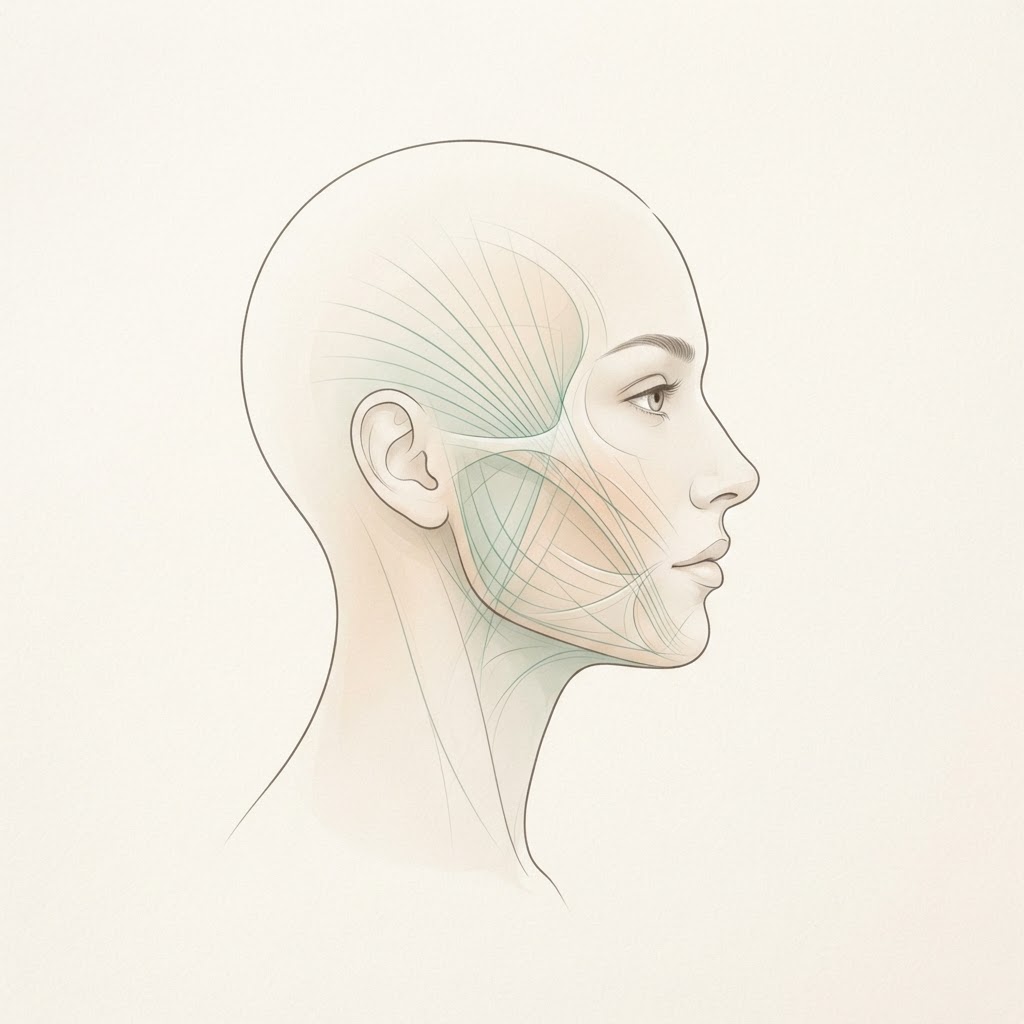
Threads placed beneath the skin provide temporary support. The tissue is repositioned or held slightly differently while the thread remains intact, and some thread systems are designed with barbs or cogs that grip tissue to hold it in place.
As the material is absorbed over the following months, that support gradually diminishes. A collagen-related effect is sometimes discussed as an additional benefit, but it is less predictable than the mechanical support — so it should not be the basis for deciding on treatment.
Because the change comes from supporting the tissue you already have, thread lifting does not remove skin and does not alter the deeper structures that a surgical facelift addresses.
Your Treatment Experience
Five stages, from facial assessment through follow-up.
Consultation & Facial Assessment
We assess your facial structure, tissue quality and areas of concern, and review your history and any previous aesthetic treatments.
Personalized Treatment Planning
Your provider maps the areas to be treated and explains the technique, the number of threads anticipated, expected discomfort and downtime, costs and alternatives.
Preparation & Local Anesthesia
The treatment area is cleansed and local anesthetic is used to improve comfort during placement.
Thread Placement
Threads are placed beneath the skin according to your plan. Most clients describe tolerable pressure or a brief pulling sensation.
Recovery & Follow-Up
You receive aftercare instructions, including what to avoid while the tissue settles. A follow-up visit reviews comfort, healing and the result.
Results & Longevity
Some lifting or repositioning may be noticeable relatively soon after treatment, while any collagen-related change, if it occurs, would develop more gradually. Swelling in the first days can make an early assessment difficult.
Results are generally temporary, because the threads are absorbed by the body. How long any change remains visible varies with your anatomy, the type and number of threads used, the technique and your individual response — so no specific duration can be promised.
Thread lifting is not a surgical facelift and does not replace one. Where significant laxity or excess skin is present, surgery may be the more appropriate option, and you should feel comfortable asking about that comparison.
Results vary
Individual results vary and are not guaranteed, and the effect is usually subtle rather than dramatic. No specific duration of results can be promised. Consistent photographs taken over time help track change objectively.
Risks & Recovery
Most people return to light activities the same day or the next. Swelling and bruising are common for a few days, and temporary dimpling or a feeling of tightness usually settles over one to two weeks.
Strenuous exercise, dental work, facial massage and excessive facial movement are avoided for a period afterward, and sleeping face-down or directly on the treated side is discouraged initially. Your provider will give you specific aftercare instructions.
Less common but important complications
As with any treatment that places material beneath the skin, serious complications are possible even if uncommon. These include persistent dimpling or puckering, asymmetry, thread visibility or extrusion through the skin, infection, and injury to nearby structures. Some of these may require a follow-up visit, an adjustment, or in rare cases removal of a thread.
Contact us promptly if you notice increasing pain, spreading redness or warmth, discharge, or a thread becoming visible. A clinical evaluation determines whether thread lifting is appropriate for you in the first place.
Frequently Asked Questions
PDO thread lifting and aesthetic treatments are available at our Rancho Cordova clinic, serving clients across Sacramento, Folsom, Roseville and surrounding communities. All treatments require an in-person consultation and clinical evaluation to determine candidacy.
Need Help Deciding?
General questions about services or pricing?
Want personalized treatment recommendations?
Wondering whether PDO threads are right for you? Meet with a provider to review your anatomy, your goals and your options.
$99 applied toward an eligible treatment when you proceed within 30 days.
Request a consultation to review whether PDO thread lifting may be appropriate for your goals. Our team will contact you to finalize scheduling.